

Celebrating 25 Years of Design Creativity using Lighting Reality PRO ✨
📢 WINNER ANNOUNCED!
Castle Gardens – Swansea City Centre Lighting Scheme
Submitted by: Wyn Davies, Senior Lighting Engineer, Swansea Council
🎉 To celebrate 25 years of helping lighting designers bring spaces to life, back in October, we launched the Lighting Reality Shining Moments Showcase to explore what we have achieved together over the years and how Lighting Reality PRO contributed — we invited lighting designers to share their favourite project created using our software.
Here’s a reminder of what we asked submissions to include:
- Innovation – new technique or novel approach used in the design of the project.
- Efficiency – demonstration of the energy efficiency of the design.
- Ecology – demonstration via the selection and application of equipment of the protection of flora and fauna and biological organisms within the environment.
- Economy – Cost of construction and revenues for maintenance.
- Astrology – Protection of the night sky, Dark Skies compliance.
🗓️ Of course, projects executed in the past will not have been subject to the same standards and criteria as they are today.
Shining Moments Showcase – Shortlisted Projects
Project #2A Gold Hill, Shaftesbury, Dorset
Submitted by: Simon Bushell MBA DMS IEng FILP, Lighting Design Manager, Enerveo
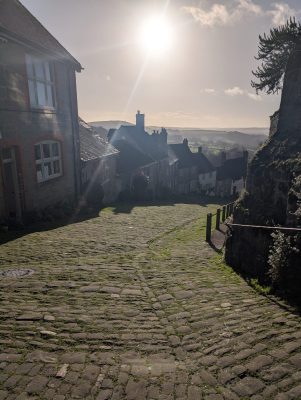
Image#1 Gold Hill – Image Credit: Enerveo Lighting Design
Gold Hill at Shaftesbury in Dorset was a challenging project that required unique solutions, modelled with flexible design software
The Public Finance Initiative contract for Dorset County Council Street lighting required the replacement of the existing lighting in Gold Hill and St James Street with new lighting to an agreed standard. This had proved to be a challenge as the existing lighting did not meet any recognisable standard.
Gold Hill is arguably one of the prettiest streets in the county and one of the steepest. Most people would recognise it from the Hovis advert where a delivery boy pushes his bike up the cobbled street past charming little thatched cottages. The project started with a public consultation meeting to determine people’s expectation; the main feedback was they don’t like change and were happy with the way things were.
Planning approval for anything was also going to be needed as the existing wall lights were mounted on the front face of the Grade II listed buildings. The original lighting had been installed in the 1970s and although not the most attractive or appropriate, they had aged and blended in with the buildings. Replacing them with anything new in the same place was likely to create issues.
The slope of the road would have a significant impact on the horizontal illuminance, which is where the Lighting Reality Pro feature to creating sloping grids would allow this to be modelled. Although I had few previous opportunities to use sloping grids, they proved relatively simple in Lighting Reality, and I had more trouble trying to establish the gradient of the slope finally resorting to information provided from cycle clubs who were mad enough to try riding up it. After setting up the grids, I could then explore options to achieving a compliant solution.
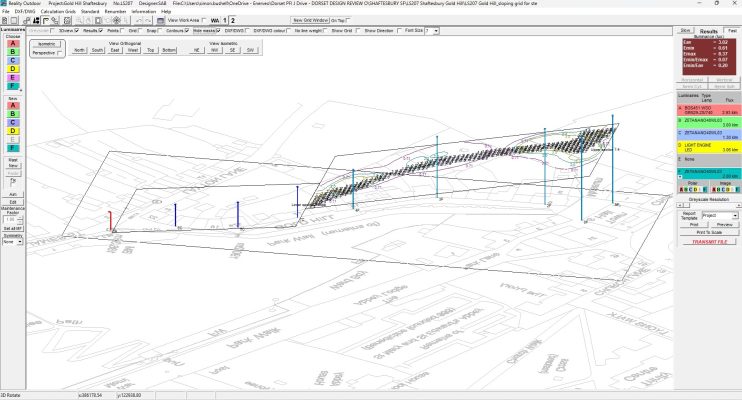
Image#2 Gold Hill Sloping Grid – Image Credit: Enerveo Lighting Design
Even achieving the low target class of P5 was going to be difficult because of the all the buildings’ listings and there was no realistic possibility of attaching any additional lights, and even the cobbled road surface is listed, as was the opposite wall of the Grade I former Abbey. There were numerous wall lights on the market similar in profile to the existing 1970s fittings. Importing optics into my Lighting Reality Pro database and using group setting allowed flicking through photometry to see that many possible luminaires had inadequate optical performance. Eventually finding one that could provide a suitable distribution from the existing positions it was put forward for a site trial but was immediately rejected by most residents when they saw the fitting. Even a proposal of heritage square Victorian lanterns was considered, as two had been fitted at the top of Gold Hill on the Town hall, although I never believed this was right for the road, but it was put into the melting pot of consultation and rejected at public meeting.
Having established that a like-for-like approach with existing position were not going to be accepted. I could push forward with what from the outset I had always believed to be the right solution. This was moving the light positions and mounting them to inconspicuous positions under the thatched eaves. Though this did give better height for design and under eave was the best protection for dark skies. Using conventional LED floodlights was not viable as they would physically project too far out. What was needed was something small that could fit under the eaves but still give the necessary distribution. Scanning the market for anything that was small enough, the only units found lacked the distribution required.
Around this time, I happened to see a new Zeta road lantern and a solution came to mind that with some alteration to the mounting, it could be what I was looking for. The Zeta light was unique in its design compared with moulded road lanterns, as it was formed from a simple aluminium extrusion. The extrusion was capped at one end with the spigot mounted the other end to form the lantern. It was apparent that this simple lantern could be easily adapted to become a wall light, simply by replacing the cap and spigot ends with a wall mounting plate. Though this mounting arrangement rotated the orientation of the lantern 90o the single LED cluster and optic could then be easily rotated within the lantern, back to face the street.

Image#3 Lantern Under Eaves – Image Credit: Enerveo Lighting Design
Gold Hill is very steep, presenting another challenge for the lighting designer as using the optic horizontally would give very poor distribution, but to tilt the lantern on the building would look aesthetically wrong and draw attention to the lantern. The solution found was the fabrication of a wedge ring that tilted the optic within the lantern; this allowed the lantern to stay mounted horizontally and not have a jarring appearance. In Lighting Reality Pro the photometry of the optic was then adjusted consistently with the “Cant” of the wedge ring. The slope of Gold Hill fluctuates so a choice of two wedges of 10 and 15 degrees were required.
I passed my design to Enerveo construction teams to build, though it did take over a year to finally get all the legal agreements to install the lanterns. I still take pride in seeing pictures looking down Gold Hill knowing the lanterns are there doing a good job of lighting the street, but more importantly on newer photos you can’t see any lanterns on the quaint cottages.
Project #B3 Riverside Park, Western Avenue, Andover
Submitted by: MEC Consulting Group – Lighting Team

Image#1 Riverside Park – Artist Impression – Image Credit: Jean‑Francois Pflumio, LUC – Land Use
The Riverside Park scheme in Andover represents a purposeful blend of technical diligence, ecological sensitivity, and community-driven design, all underpinned by modelling, calculations, and verification completed using Lighting Reality PRO. The goal was to elevate a previously underused river corridor into a safe, welcoming, and environmentally respectful public space. This submission focuses on five key areas: innovation, efficiency, ecology, economy, and Dark Skies protection.
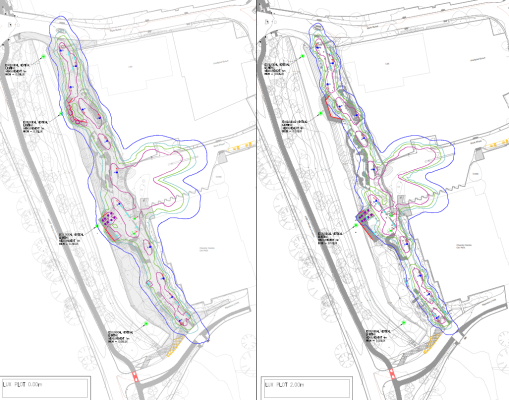
Image#2 – Image Credit: MEC Consulting Group
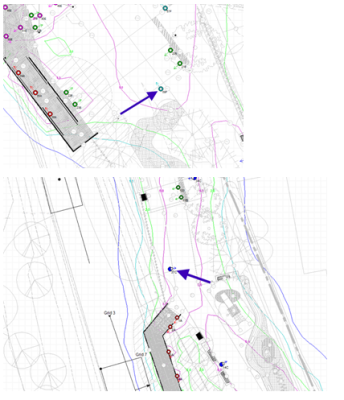
Image#3 – Image Credit: MEC Consulting Group
Innovation
One of the most innovative aspects of this project was the introduction of a dynamic, adaptive white-light strategy that modulates correlated colour temperature (CCT) based on activity levels and ecological sensitivity. The DW Windsor Daytona luminaires selected for this scheme were programmed to operate at 3000K in the early evening, supporting visibility, facial recognition and safer pathways, before gradually reducing to 2200K around midnight to protect the bat corridor running along the River Anton. This approach created a lighting environment that shifts naturally with human activity patterns while maintaining an ecologically responsible spectrum.
Lighting Reality PRO played a critical role in achieving this. By enabling the testing of various CCT profiles within accurate 3D-modelled site conditions, the software ensured that colour temperature reductions would not compromise safety, uniformity or route legibility. The modelling made it possible to trial alternative CCT and intensity scenarios in minutes rather than hours, supporting rapid iteration during the design upgrade prompted by pre-application police feedback, which required improvements in facial recognition, vertical illuminance, and user perception of safety.
The design also incorporates asymmetric handrail lighting along the walkways using Garda fittings. This directs light away from the river surface, something validated through detailed photometric testing in Lighting Reality PRO, and provides essential route definition without contributing to sky glow or ecological impact.
A layered lighting approach was also introduced, including under-bench lighting, carefully positioned columns, and selective bollards. This tailoring provides just enough vertical and horizontal illumination for route confidence while preserving a sense of darkness appropriate to a riverside ecosystem. This layered method was mapped and refined entirely within Lighting Reality PRO to ensure each element contributed effectively without over lighting.
Lighting Reality PRO was also used live in design team meetings to show predicted light levels at nearby ecologically sensitive areas with different light fittings and locations to present to both clients and project architects why certain lighting products could or could not be used.
Efficiency
Energy efficiency was another core measure of success. Using Lighting Reality PRO’s Energy Performance Indicators and calculation tools, the design was refined to deliver the required levels of safety and usability while minimising overall power demand.
Key measures included:
- Use of high-efficiency luminaires with precise optical control reduces wasted light.
- Zero upward tilt and use of horizontal cut-off optics to prevent overspill.
- Removal of the majority of bollard lighting following modelling, replacing them with fewer, strategically positioned columns that delivered better performance with lower energy consumption.
- Part-night dimming options, validated through Lighting Reality PRO, show that late-night lighting levels could be significantly reduced without breaching safety or uniformity requirements.
The software enabled lux level modelling across the entire site and showed that the target illuminance on the primary footpaths could be achieved with a relatively low total load per luminaire. Real-world data from the baseline survey (lux ranging from 1.13–12.61 lux across different areas) informed the energy modelling approach to align with the ambient context and avoid unnecessary intensity increases.
Lighting Reality PRO provided certainty that the proposed design would meet performance standards while keeping overall energy usage minimal, a point particularly relevant for a local authority managing long-term operational costs.
Ecology
Protecting flora, fauna and especially the bat corridor along the River Anton was a defining requirement of the scheme. Following ecological consultation, receptor points were added at 1m, 2m and 4m heights along the river, and the lighting design was built to ensure all stayed below 0.4 lux vertical and 0.2 lux horizontal, thresholds recommended for bat protection. Lighting Reality PRO allowed us to precisely calculate vertical illuminance at each receptor, resulting in readings between 0.09–0.38 lux vertically and 0.05–0.16 lux horizontally, all safely within ecological tolerance ranges.
The selection of equipment within the Lighting Reality PRO database contributed significantly to this outcome:
- 2200–2700K luminaires and handrail lights reduce blue-light content known to disrupt foraging and commuting patterns.
- Asymmetric optics on handrail lighting prevent riverward spill, a factor validated within the model.
- Zero-tilt luminaires reduce sky-facing output.
- Low-powered, controlled bollards maintain safe transition areas without adding excessive vertical light.
Additionally, Lighting Reality PRO’s ability to simulate interactions between artificial lighting and surrounding environmental structures helped ensure the design supported ecological integrity across the entire corridor. These results gave the ecological team confidence that the installation would not interfere with species known to inhabit and travel through the area.
Economy
The economic value of the lighting design was maximised through the use of Lighting Reality PRO Optimisation combined with energy modelling. By simulating multiple layout variations, the team achieved:
- Fewer columns with improved lighting uniformity.
- Reduced cabling and trenching costs.
- A longer-term reduction in maintenance burden due to lower luminaire count and higher durability fittings.
- Smart dimming profiles that reduce operating hours for luminaires.
This proactive modelling saved design hours, reduced risk, and ensured that the investment made by Test Valley Borough Council translated into a long-term, low-maintenance solution.
Astrology / Dark Skies Compliance
Finally, the Riverside Park design supports Dark Skies principles and demonstrates strong compliance with ILP GN01/21.
This was validated through:
- Photometric selection ensuring minimal upward light.
- G-class and Imax evaluations, confirming controlled light distribution and low potential for glare.
- Use of warm-white sources (2200–3000K) to minimise atmospheric scattering.
- Zero upward tilt on all luminaires to prevent sky glow.
Lighting Reality PRO provided assurance that the new scheme would not contribute significantly to the night-sky brightening already present from surrounding streets, car parks and commercial lighting.
Project #4C Castle Gardens – Swansea City Centre Lighting Scheme
Submitted by: Wyn Davies, Senior Lighting Engineer, Swansea Council
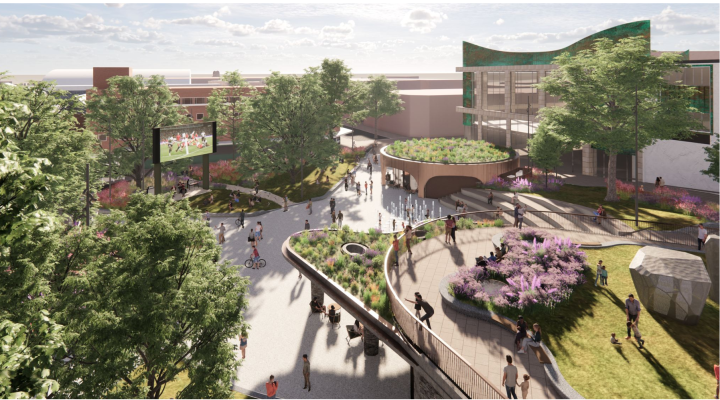
Image#1 Castle Gardens – Image Credit: Swansea Council
Project Description
Castle Gardens is a landmark public space in the heart of Swansea city centre, designed to create a safe, vibrant, and visually stunning pedestrian environment. The scheme combines functional lighting for safety with architectural lighting for aesthetic impact, ensuring the area becomes a focal point for community engagement and cultural events.
The design uses 10m height columns, each fitted with multiple luminaires arranged in a helical pattern to deliver uniform illumination across the main thoroughfare. Warm white 3000K lanterns provide a welcoming atmosphere for pedestrians, while RGB colour-changing luminaires illuminate trees, predominantly in green but dynamically shifting for special occasions such as St David’s Day or Swansea’s Purple Flag Award celebrations.
To enhance the visual experience, GOBO projectors create patterned effects on the central plaza floor, and a larger gobo projector highlights the historic Swansea Castle across the road, reinforcing the cultural identity of the space.
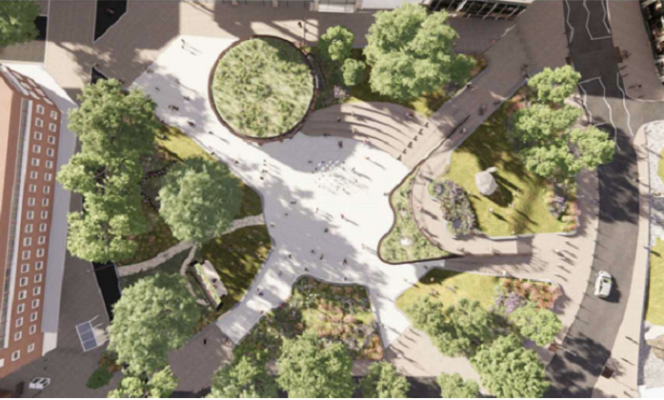
Image #2 Castle Gardens – Image Credit: Swansea Council
Innovation
The original concept proposed lanterns evenly distributed around each column in a full 360° arrangement. However, this approach would have resulted in unnecessary illumination of adjacent green spaces, leading to energy inefficiency. Instead, the final design strategically positions lanterns to target key pedestrian routes and focal points, significantly reducing energy consumption while maintaining visual impact and compliance with lighting standards.
Further innovation included:
- Relocating columns originally placed within tree canopies in the manufacturer’s design, which was unacceptable for both aesthetics and maintenance. The revised positions improve lighting effectiveness and protect the landscape.
- Dynamic RGBW tree lighting integrated with event programming for cultural flexibility. · Gobo projection introducing artistic elements, transforming the space beyond functional lighting.
Lighting Reality PRO was instrumental in achieving this innovation by enabling:
- Precise column equipment mapping, including height of each luminaire and projector, orientation of access doors, and column numbering with sub numbering for each fixture.
· Rapid scenario testing to compare 360° distribution against strategic placement, ensuring the most efficient and visually appealing solution.
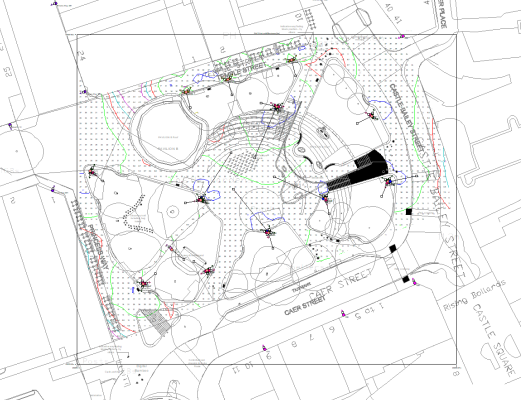
Image #3 – Image Credit: Swansea Council
Efficiency
The initial manufacturer concept consumed 1833 watts for the main lighting using 47 lanterns. Through optimisation and strategic luminaire placement, the final design uses only 978 watts with 29 lanterns—a reduction of 38% in lantern count and nearly 47% in energy consumption. Additional power is required for RGBW LED lanterns and GOBO projectors, which were not included in the manufacturer’s original design but add significant visual and cultural value.
Using Lighting Reality PRO Energy Performance Indicators, the design achieves:
- Average Maintained Illuminance: Meets BS EN 13201 standards for pedestrian areas. · Uniformity: Verified via photometric calculations.
- Energy per m²: Reduced by minimizing over-lighting and using efficient LED technology.
Ecology
- Flora and Fauna Protection: o Warm 3000K CCT for pedestrian areas minimizes disruption to nocturnal species. o RGBW lanterns are used to illuminate the tree canopies for visual effect.
Economy
- Construction Cost Savings:
o Reduced lantern count lowered infrastructure costs significantly.
- Maintenance Efficiency:
o Detailed column numbering and sub-numbering for each fixture simplifies asset management.
Lighting Reality PRO – Unique Benefits
- Revenue Savings: Fewer columns and luminaires due to accurate photometric modelling.
- Precision: Ability to specify equipment heights, orientations, and numbering within the design file—critical for complex multi-luminaire columns.
Project #1D – St Andrew’s Church, Moffat
Submitted by: James H Paterson BA(Hons) CEng MCIBSE FILP (retired)
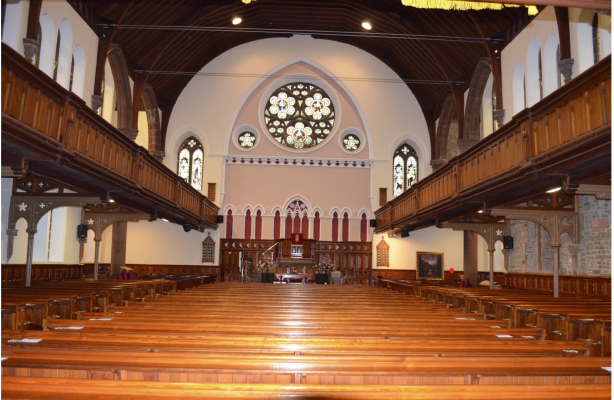
Image #1 St Andrew’s Church – Image Credit: James Paterson
There were two stages to this project, three years apart.
Stage 1 of Project (2020). Upgrading the (internal) fixed lighting system to LEDs & Communion Table Area Improvement
Fixed Lighting System Upgrade
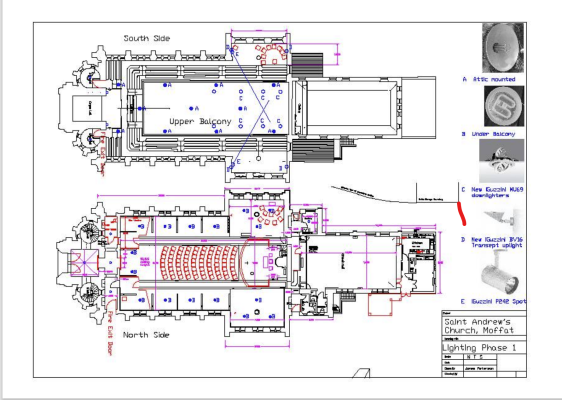
Image#2 – Image Credit: James Paterson
The existing luminaires were old Edison Swan 460mm diameter industrial metal bodies with a mixture of 300w tungsten filament and 70w metal halide control gear lamps in the attic ceiling. The luminaires in the ceiling below the balcony had the same body profile at 370mm diameter, but had previously been converted to house the body of a circular 38 watt 2D square fluorescent.
The luminaire bodies were separate from the ceiling mounted glass diffusers and could be removed without disturbing the diffuser. The 3 luminaires down the centre appeared in poorer condition than the side isles. 150w MBI on pendant E27 caps.
The balcony ceiling units were accessed by lifting short sections of floor boards between the balcony pews. These units were not individually isolatable as has been provided in the attic. No allowance had been made in this phase for this facility.
The replacement of the luminaire light source, with an LED option was selected, resulting in considerable savings in energy use and carbon emissions. Since lower wattages were needed to effect the same levels of illumination, this also reduced the load on the lighting circuits. However, there was a desire to increase illumination levels especially in the communion table area.
It was suggested that, the existing general lighting within the church area be upgraded to current standards with modern LED lamp types replacing those currently in use. This incorporated the re-use of the existing luminaire bodies and glass diffusers. Other existing lighting was amended to suit the future alterations.
Likewise the existing lighting below the balcony was upgraded with 3,000K LED as follows:
Old luminaires removed and debris vacuumed out from all 16 under balcony diffusers.
Removal of old gear trays and plastic bodies.
Terminal block and led drivers fixed to plastic body and refixed to old industrial metal body.
17w version including DALI control.
Initial consideration was to install terminal block, driver and 3xx mm diameter LED disk from iGuzzini BOS range. 27w giving 4,300 lumens into old unit. Time consuming but 27w operation managed by church fabric fellowship. 17w (18.2 circuit watts) version at 1976 lumens disk is 240mm dia fitted over existing ceiling mounted diffuser without the need to adapt.
Visually brighter than existing 2D units.
Communion Table Area Improvement
The communion table area needed about 200 lux and there were already 4 ventilation points in the ceiling above.
The hole measured 235 to 240mm and an adapter plate was made to fill the gap to support new downlighters requiring 196mm hole.
Pixel Plus downlighters MU 64 or 70 equivalent in LED spotlight with 18/36/420 beam Probably 180 or 360 needed MU 69 with DALI. Drop to floor below = 13.5 metres, 4 essential plus 2 more.
Installed source was 150w PAR38 and location was just less than 1200 splay recommendation.
Upper transept roof woodwork needed brightening (it was originally illuminated years before).
Original spotlights (disconnected) for pulpit and communion table were reinstated with modern narrow angle circular symmetric equivalent to 150w CDM/T or 3000K LED) 2 required – about 10m mounting with 14 to 15 metres throw to dias.
Matching asymmetric CDM/T to reinstate old disconnected upper transept area uplight flood Possibly 4 needed but start with 1 in each transept opposite to spot.
iGuzzini iTeca BV16 28w LED 2280 lumens.
Wall wash PO14 quoted (may not wash complete ceiling).
Stage 2 of Project (2023). Proving that the previously upgraded lighting met emergency lighting requirements and did not need to be replaced by a completely new lighting system.
The proposal involved the removal all 16 under balcony iGuzzini led discs, to which I objected (as one of three trustees overseeing the project).
As a result, I produced a calculation showing that 5 or 6 of the under balcony units would meet the minimum illumination of 0.5 lux, in the main body of the church, if the existing iGuzzini discs were fitted with emergency backup packs.
Using Lighting Reality, and since there was little need to allow for interior wall or ceiling reflections, I produced a “worst case” interior scenario.
Having enjoyed using the software in a manner which I had never used before, I continued to apply the calculations to other parts of the church. The final version of the attached Autocad layout (Image. #3) was produced by copying 7 separate calculation grids into one drawing.
Both the architect and the contractor were impressed and accepted my amendments to the proposal. As a result, none of the previously installed iGuzzini units were required to be replaced.
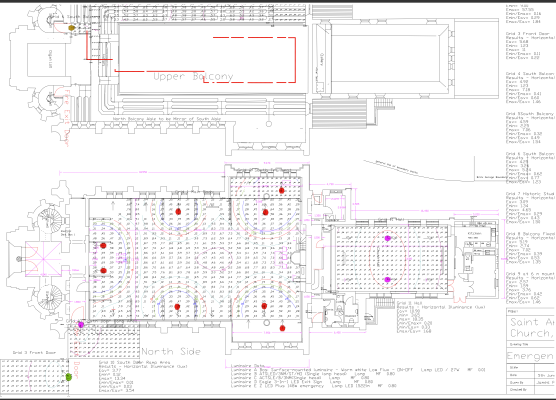
Image#3 – Image Credit: James Paterson